Friday, November 14, 2014

The Plague


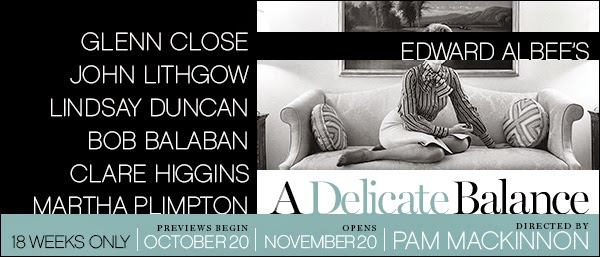
If you didn’t see the 1996 revival of A Delicate Balance with George Grizzard, Rosemary Harris and Elaine Stritch, then you will undoubtedly enjoy the current revival with John Lithgow, Glenn Close and Lindsay Duncan. Close uses the logic of Agnes like a weapon and a shield; Lithgow embraces the lost, bemused distance of Tobias; Lindsay Duncan (I dare you to find a syllable of her American accent that isn’t authentic) makes Claire a lost soul as well as a spirit guide (spirit as in liquor, mostly);  and Bob Balaban and Clare Higgins as Harry and Edna are fabulously offbeat, with Balaban down for a drink one moment and down the rabbit hole the next, and Higgins making you hate Edna almost immediately.  Only Martha Plimpton  as daughter Julia feels like she’s in a different play.  She is all bark and no bite—literally:  she delivers her lines like a tourist in a foreign country who thinks that speaking English loud enough will make the  natives understand her. 

So yes, on its own merits, this production is funny, it’s sharp, it’s disturbing, and it’s very entertaining.  The thing is, the 1996 version was all those things plus terrifying, which exposed a level in the play that is only glimpsed in one or two moments in this production. 

What’s this production missing?  I think of it as the Undertoad.  (And thanks for embedding that one in my brain 36 years ago, John Irving.)  In this play, there’s a crack in the ice that everyone ignores.  Agnes skates around it, Claire drinks so she won’t see it (and then drinks some more so she can get the courage to jump up and down on it), daughter Julia gets married to run away from it, Harry and Edna acknowledge it, and Tobias goes along to get around it.  Without that crack in the ice, the play runs the risk of being a glib comedy of bad manners, with a lot of laughs that should be nervous and add to the tension, instead of being, well, comforting.  And Tobias becomes a henpecked hubbie instead of someone who’s so afraid of thin ice that he measures and weighs every step he takes.  And because Lithgow doesn’t do that, there’s no sense of the lava in Tobias that causes his eruption in Act Three. 

Also (and I don’t think there’s a word for this, so let’s call it hop scotching) a lot of the time, the actors are moving before they’re grounded—reacting before they’ve taken in the thing they’re reacting to.  If this was music, they’d be coming in before the downbeat, and with the same off-tempo result.  The strong moments are weakened and diminished because characters are acting out the results of a decision that is skipped over—they’re hop scotching over the moment when they take in the fact that they’ve been attacked or questioned or defeated, a moment they have to acknowledge before responding to it or else there’s no gravity behind anything they do. 

The only one not guilty of this is Lindsay Duncan, who spends a great deal of this production living in and reacting to a deeper version of the play than is presented onstage.  Her reactions retroactively raise the bar on everything that’s going on.  But never to the level of the bar that was set by the 1996 revival.

So if you never saw that revival, go see this one. 
And if you did see that revival, go see this one as well—because it will, by what is absent in it, reinforce everything that made the 1996 revival a classic.


Wednesday, November 12, 2014

Feminism


When something in you hurts or causes pain,
   You fight it with a dose of something strong—
Take medicine until disease is slain;
   Pop pills to counteract whatever’s wrong.
And that’s what Feminism is: a cure
   To stabilize the body politic—
Fighting an ill with medicine so pure,
   The fear of taking it makes some men sick.
Like casts are burdens once you heal the break
   And wheelchairs useless once you’re on your feet,
The point of Feminism is to make
   The need for Feminism obsolete.
      It’s not about enforced diversity—
      It’s about healing inequality.
 
Copyright 2014 Matthew J Wells


Monday, November 10, 2014

Byron and Shelley at the Edinburgh Fringe Festival


While attending the Edinburgh Fringe Festival, Byron and Shelley obtained lodgings from a local lawyer who had two beautiful daughters named Faith and Hope.  Because of the thickness of their accents, Shelley thought of them as Feth and Hawp, and while Feth was the prettier of the two, she did not hesitate to express a flood of aggressively vocal opinions about everything from the weather to politics, and spoke so constantly that it would have taken a medical examination to determine exactly how she managed to breathe.  Shelley much preferred Hawp, a demure and respectful creature who had little to say about anything at all while in her sister’s presence, but she was smitten with Byron.  

On their second night in town, Shelley took Feth to see a comedy from England, during which she continually whispered comments, questions and opinions about the acting.  Meanwhile, Byron took Hawp out to dinner, and the moment they sat down, Byron found himself in the company of a woman who was just as vocal, twice as opinionated, and ten times as discontented as her sister.  His sole contribution to her unceasing flow of invective and dissatisfaction was the occasional grunt of sympathy and the infrequent interjection of the words “Oh really?”  “Do you now?” and “Is that so?” 

At the end of the evening, having bid their respective dates good night, the two men retired to their chambers in a state of wearisome distemper. 

“How was your evening?” Byron asked. 

“Oh it was Intolerable,” Shelley declared.  “The Creature chattered away throughout the entire Performance.  She is a sad Paradox, Byron—her opinions are as Odious as her features are Beautiful.  And how was your dinner with Hawp?”
 
Byron shook his head sadly. “It was a date worse than Feth,” he replied.


Copyright 2014 Matthew J Wells

Thursday, November 6, 2014

Lear's Daughters


Three Daughters Of King Lear by Gustav Pope


There were three sisters once upon a time:
   One sister was as brutal as a fact,
One sister spoke of law and dreamed of crime,
   And one had all the heart the others lacked.
There were three girls who served an angry fool:
   One kept the peace, one tried to be endearing,
One gave advice that hid her ridicule,
   And all three learned the trick of disappearing.
There were three daughters of a lonely queen:
   One was the softness that she had to hide,
One was the need that made her feel unclean,
   And one the hate that burned her up inside.
      Three princesses: one hard, one soft, one shrew;
      One warm, one cool, one sly—and all untrue.
 

Copyright 2014 Matthew J Wells

Monday, November 3, 2014

Everything that our eyes see is a vision


Everything that our eyes see is a vision
   That our eyes were constructed to believe
Is worth a look.  Each glance makes a decision
   About what it will not or will perceive.
Sight is a tool that’s differently endowed—
   Dogs can’t see colors, cats stare at a ghost,
And we see faces in a passing cloud
   And Jesus in a piece of melba toast.
We look upon the world like it’s our book,
   But it’s a mirror—it needs us to be.
We see ourselves no matter where we look
   And never see past what we need to see.
      So tell me, love, and always tell me true,
      What I’m not seeing when I look at you. 


Copyright 2014 Matthew J Wells


Friday, October 31, 2014

The Elephants In The Room


You see me here, standing in front of you;
   I see you standing there, looking at me.
Behind us is what we have both been through;
   Ahead of us is what we’ll do and be.
Six people, any one of whom can make
   Life hell for all the others in this room.
Maybe your past will be our poisoned snake;
   Maybe who I am now will cause our doom.
And maybe who you want to be will judge
   The lot of us and coldly cut her losses,
Or who I want to be will hold a grudge
   Because the other five act like his bosses.
      Our love will die, unless we have the smarts
      To satisfy our past and future hearts.


Copyright 2014 Matthew J Wells


Thursday, October 30, 2014

Shut Up, Henry.


The running gag in Woody Allen's Bananas is "There's something missing."  "There's something missing and I don't know what is," says Louise Lasser every time she and Allen get together.  You'll walk out of the Roundabout's production of The Real Thing saying much the same thing, probably along the lines of "There's something missing and I know exactly what it is."  Namely: heart. 

Because of that, the play’s cleverness feels like a series of lectures by the author rather than a series of scenes with characters.  And having the cast do sing-alongs and humalongs of the pop songs that play every time a scene changes only adds to the distancing.  It’s very Brechtian, but the last thing a Stoppard play needs is lehrstücke.  Take it from someone whose default mode is clever: the only way clever works is if it is an impeccably tailored ensemble which is cut to specifically cover a very dramatic abnormality.  In this production, the suits are empty.    

This is especially true of the main character, Henry, played by Ewan McGregor.  Because there’s no depth beneath them, McGregor's long speeches seem twice as long as they should.  You want  somebody to interrupt him, not because he's talking around something he can’t say, but because he's talking to no purpose, or talking because he's an annoying if clever chatterbox.  You wonder what Maggie Gyllenhaal sees in him.   

All of which would be forgiven if he actually got some laughs, but he doesn’t.   This is true of everyone.   This production is just not that funny.  As a result, you have time to do the most dreaded thing an audience can do during a comedy: ask questions.  Like:  what is this political subplot doing here?  How come the daughter of the divorced marriage never shows up until whatever she feels about the divorce is not an issue anymore?  Will Maggie Gyllenhaal actually get an emotional reaction out of McGregor?  Why can’t we see more of Josh Hamilton?  And what pray tell is that accent Cynthia Nixon is doing? 

And—the deadliest question of all—what is Stoppard actually trying to say?   When you’ve got a long impassioned speech about the need for precision in writing which is spoken by a man who is passionately in love with pop songs from the Sixties, it’s clear that the implied contradiction is supposed to be at least a character revelation, if not a message.  But by the end of this production, all I could think of was that I had just watched a long-winded response to the pithy Noel Coward line: “Extraordinary how potent cheap music is.”

And it made me desperate to see Indian Ink again.
 

Wednesday, October 29, 2014

Transformer

Lewis Allan Reed
March 2, 1942 – October 27, 2013


Is there a song on either side that’s not
   About a drug?  The needle plays a track
About a needle and a track, that’s hot
   With innocence we’ll never rehab back.
We walk the wild side now, and work those hips.
   We are invulnerable: we are young.
A perfect day is when we kiss the lips
   Of overdose, but never feel her tongue.
It’s a gone world where nerves are strung as tight
   As Link Wray’s axe, and New York conversations
Are scored by Charlie Parker’s sax all night,
   And dealers always discount favored nations,
      And heroines do heroin and know
      You always have to reap just what you sow.


Copyright 2014 Matthew J Wells


Monday, October 27, 2014

After Such Knowledge, What Forgetfulness?


We are the only living things who know
   That we will die, and then we all forget it,
So we can live.  When friends and family go,
   We’re wounded, but we always tourniquet it
By saying: “That’s the rule—I’m the exception.
   Everyone has to follow it but me.
The whole world’s born to live a misconception.
   They get a lifetime; I get eternity.”
I’ll take my final breath on my last day,
   Thinking: “Not me.  Not me.  Not me.  Not me.”
Hearing: “Yes, you.  Even you,” as I pay
   The debt that’s due to my mortality.
      All that’s for publication; but in private,
      Deep down, I know—I KNOW—that I’ll survive it.


Copyright 2014 Matthew J Wells

Thursday, October 23, 2014

The Hardest Thing About Rewriting


The hardest thing about rewriting is
   Cutting the lines I love.  They may not ever
Contribute to the play but they have fizz.
   They flow and snap and entertain; they’re clever.
But clever is a paint job, not the house.
   It should enhance the inside, and not smother
Or contradict—like when your favorite blouse
   Says one thing but the outfit says another.
It’s all about the structure, and rebuilding
   Out from the inside till it’s all one whole,
With solid levels, no excessive gilding,
   And architectured lines.  My writer’s goal:
      To make with my clawed hand and Vision pen
      Something I won’t have to rewrite again. 


Copyright 2014 Matthew J Wells