“Aw-w-w-w-w,” said the
woman behind the counter at Shakespeare & Co when I bought The Martian
Chronicles and The Illustrated Man last Friday. I smiled sheepishly, as if to say, "Yeah, I feel
like an idiot having to buy them again, but damned if I know where my original
copies of these are.”
“We must be all out now,” she
said.
I shook my head. “One left of each. Which is more than any Barnes & Noble in
the city.”
“You’re joking.”
“Nope. Looked it up online. Out of stock everywhere.”
“Well that’s a crime.”
“If it is, it’s the kind
of crime independent bookstores were created to solve.” Then I went “Heh,” and smiled, and said, “That
sounds like the kind of story Bradbury would write, doesn’t it?"

The first Bradbury I ever read was in seventh-grade English class in 1964. It was an excerpt from Dandelion Wine--I forget what it was called as a short story, but in the book, it's the chapter about the serial killer called The Lonely One, and how a couple of women find the dead body of one of his victims in the ravine as they’re on their way to the movies, and how one of the women, the coolest and the calmest of them, gets more and more frightened as she walks home alone, until she finally gets into the safety of her home, all of which is a set up for the final ten-word sentence, which took my breath away when I first read it. And still did, when I re-read it on Friday. I didn’t know it was from Dandelion Wine until later, and if you ask me to label that story even now, I wouldn’t say it was science fiction. And Dandelion Wine itself, with its picture-precise boy’s-eye-view of the world, and its various takes on time machines? Call it the birth of magic realism. In the country of imagination, Green Town Illinois in 1928 is just across the river from Macondo.

Of the original fantastic
four--Asimov, Bradbury, Clarke, Heinlein--Bradbury outlived them all. I want to add “in life, as he will, from now on, in
the literary afterlife,” but that’s as up in the air as a rocket ship. More people read Emily Dickinson last week
than they ever did while she was alive; who could have predicted that? Not Emily, certainly. And when it comes to science fiction, it’s
even harder to predict. (Which is a kind
of a pun, yeah.)
Why do I think Bradbury will outlive them all? Well, the Big Four had very different views of science. The easiest way to think of it is, if there’s a rocket ship, then Clarke tells you
how the engine works, Heinlein gives you the politics behind the rocket's construction, Asimov shows you the effect of rocket ships on society, and
Bradbury tells you a story about the crew. In his science-fiction stories, people trump technology. Which makes the best of those stories timeless, because (so far at least) the big difference between human nature and technology is that only technology ever changes.

The fact that science
fiction is a large enough province to claim both Clarke and Bradbury as model
citizens ought to remind us not only of how false genre labels can be, but how
certain attitudes and expectations can carry implicit value judgments. Like, for instance, “Bradbury didn’t have
enough science to be a true science fiction writer.” Meaning like Clarke, or Larry Niven, or Ben
Bova. To which you could say “Neither
did Philip K Dick, and he couldn’t write an elegant sentence if he transcribed
The Importance Of Being Earnest.” A reply which, I think,
points to what makes Bradbury Bradbury.
The writing. He’s
more like a well-adjusted Poe than a Clarke or an Asimov. In a lot
of ways, their inclusion of social and technological speculation dates them
("Oh wow--this is how the 90's looked to somebody in the
40's!"). With Bradbury, it's more like: "Oh wow--what a cool
fable about (Mars/time travel/censorship/a homicidal newborn/everybody waking up one day and
knowing it’s the end of the world)."

For example: I re-read The
Martian Chronicles this weekend, and in the chapter entitled "The Third Mission,"
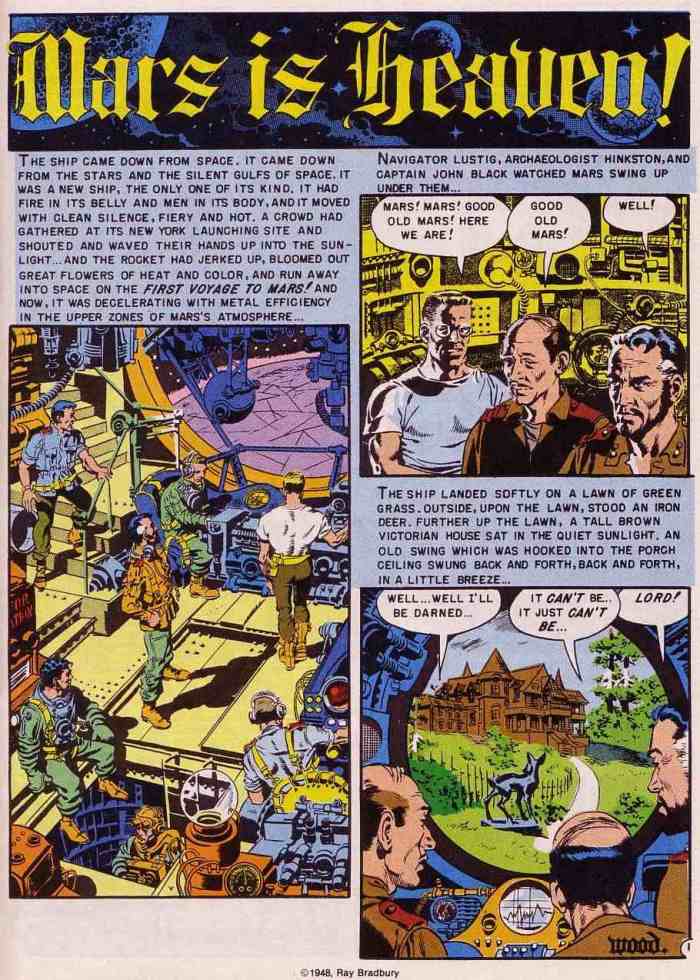
which was originally published as “Mars Is Heaven” in 1948, there’s a line that
jars like a pothole. Instead of
Martians, the crew of the ship encounters the inhabitants of a middle-America
town who all think it’s 1926. Trying to
get his head around this, Captain John Black
says:
“I didn’t ask for a thing
like this. It scares the hell out of me.
How can a thing like this happen? I wish we’d brought Einstein with us.”
Feel that bump? That’s the kind of thing you feel when you
re-read Clarke, and Asimov, and even Heinlein, and you’re brought up short by a
detail that dates the story as surely as seeing a rotary phone in a 50’s movie
about space travel. When you realize that the Mars landing in the original 1948 story was supposedly taking place in 1960, it makes a little more sense. But it’s still the kind of
chronism (as opposed to anachronism) that you don’t normally find in Bradbury.

Bradbury
may be at the same table with Asimov, Clarke and Heinlein, but to me, he’s
sitting with Poe on one side and Stephen King on the other--King, the other
child who never grew up, who can tell a story that grabs you by the shoulders
and throws you in the death seat of a Plymouth Fury and drives you to the gates
of What The Hell and back. Bradbury does the same
thing, except more politely. And,
because his natural medium is the short story, more quickly. And double and, because King and Bradbury both enjoy the dismissive condescension
of so-called Real Writers, their popularity becomes not only a badge of honor,
but an implicit critique of those who think that reading should be work and not
pleasure.

And
pleasure, in the end, is what I think will make Bradury the Poe of our
grandchildren, as opposed to the Dunsany of our grandparents. (“Who?” you’re saying. “Exactly,” I reply.)
In
the story “--and the Moon Be Still as Bright,” which is a line from one of my
favorite poems, Spender the archaeologist is trying to explain to Captain
Wilder what made the Martians different:
“They
quit trying too hard to destroy everything, to humble everything. They blended religion and art and science because,
at base, science is no more than an investigation of a miracle we can never
explain, and art is an interpretation of that miracle.”

Science
is no more than an investigation of a miracle we can never explain, and art is
an interpretation of that miracle.
Can
you see Asimov, Clarke or Heinlein writing that sentence?
I
can’t. And if they could, it wouldn’t sing
the same way, or even sing at all. That’s
what makes Bradbury stand out. Like the
best science fiction, what he wrote wasn’t just science fiction. In his case, it was poetry.
The story above was originally printed in Weird Science #18; it was adapted by Al Feldstein and drawn by (the great) Wally Wood. You can download it here.
The story above was originally printed in Weird Science #18; it was adapted by Al Feldstein and drawn by (the great) Wally Wood. You can download it here.


